

 Posts
Posts


After Roberts revelation about the stamp from the NAFAS booklet with the missing Letter A. Dave Feeney wrote to me and provided a list of all the security stamps (known to him) issued during 2009 with phosphor errors.
He informed me that he has not actually seen these stamps, but got the information from a well known online specialist catalogue.
For your information here are the stamps (complete with catalogue prices) to look out for. I have used the Deegam Sin System to identify the errors. Many thanks go to Douglas Myall for continued permission to use his copyright sin system on site.
Sheet Printings De La Rue (no code) cylinder D1
2nd class CB (s1) cat @ £8.50
1st class 2B (s16) cat @ £14.00
2nd Large 2B (s17) cat @ £16.50
1st Large 2B (s16) cat @ £25.00
Business sheets Code B
1st class 2B (I2) cat @ £11.00
Walsall
2nd code T (s2) cat @ £8.50
1st code C ex Design Classics number 2 (I1) cat @ £7.50
1st code C ex NAFAS booklet (s16) cat @ £7.50
Have you checked your 2009 stock yet? Good hunting, do not forget to check the other numerical sheet and later issues including the Prestige booklet pane. It will be interesting to see how many more (if any) phosphor errors are reported from the 2010 sheets and booklet printings .
Wednesday, 30 June 2010

Tuesday, 29 June 2010
Spot The Error

Some times just for fun we have a competition on site, It has been quite a while so I think it is high time we had another. Just to say thanks to those of you who voted to put GB Machins into first place on the top 50 website. Your votes are much appreciated, so please do continue to vote each time you visit the site.
BACK TO THE COMPETITION
This se-tenant pane was issued in the 10p London 1980 booklet, contents : 2 x 1p, Label and 1 x 8p, it was issued in Oct 1979. The stamps were Printed on the Jumelle press.
Not what you would consider a rare item and at first glance you would dismiss it as just another 10p booklet. But there is a difference to the norm if you look closely.
Last week I was at a stamp meeting and picked this up along with several other booklets, this one was actually sold for the bargain price of 50c.
Can you tell me what the error is. All replies (by email) subject "booklet" will go into a prize draw and the first correct answer (to be drawn next week) will win the booklet.
Don't forget if you do not enter you have no chance of winning, Good luck,
Monday, 28 June 2010
Missing A in Flowers Booklet

Just in case you do not read the comments left on site, here is a bit of information you may be interested in, discovered only yesterday by Robert.
21 May 2009 for the National Association of Flower Arrangers (NAFAS).
"I discovered quite by chance yesterday that the gold stamps in this last booklet can be distinguished from those in the other five because of a difference in the iridescent overprint. In The word (M)AIL situated just above the left-hand security slit, the letter 'A' is missing.
21 May 2009 for the National Association of Flower Arrangers (NAFAS).
"I discovered quite by chance yesterday that the gold stamps in this last booklet can be distinguished from those in the other five because of a difference in the iridescent overprint. In The word (M)AIL situated just above the left-hand security slit, the letter 'A' is missing.
If your readers wish to be sure of having a copy of this 'variety' they still have a chance but they'll have to hurry as the booklet goes off sale at Tallents House on 2 July."
Picture above supplied by Ian Billings. norphil.blogspot.com

Here is a Royal Mail publicity picture of the booklet described in the last post "The booklet that never was."
Originally planned as the 3rd in the series 1 x Spitfire and 1 x Concorde and replaced by 2 x Concorde stamps.

Spitfire Booklet
Amended 29/06/10
January 13th 2009 seems as though it was a long time ago, in fact it was the date Royal Mail introduced the British Design Classics set.
Over the later months we had some special Customised Machin/Special issue booklets, (01) Double decker bus / phone box, (02), 2 x Mini car, (03), 2 x Concorde (04), Mini skirts designed by Mary Quant.
These customised booklets (Machins only) had a code letter C incorporated into the lettering of the background print. It you troll back through the archives on site from 2009 you will find reports on all these customised booklet issues.

The latest customised booklet to be announced from this 2009 set (Special design Classics) is number (05), The Spitfire, it is due to be released on 15th September 2010. Over a year later than it was initially announced. It is thought this was canceled and replaced by the Concorde booklet (3). The Spitfire booklet will be slotted in this year to correspond with and mark the 70th Anniversary of the Battle of Britain.
The booklet will be printed by Walsall Security Printers Ltd and the definitive stamps will continue to have MCIL and as with all booklets introduced in 2010 will also have MA10 background codes.
January 13th 2009 seems as though it was a long time ago, in fact it was the date Royal Mail introduced the British Design Classics set.
Over the later months we had some special Customised Machin/Special issue booklets, (01) Double decker bus / phone box, (02), 2 x Mini car, (03), 2 x Concorde (04), Mini skirts designed by Mary Quant.
These customised booklets (Machins only) had a code letter C incorporated into the lettering of the background print. It you troll back through the archives on site from 2009 you will find reports on all these customised booklet issues.

The latest customised booklet to be announced from this 2009 set (Special design Classics) is number (05), The Spitfire, it is due to be released on 15th September 2010. Over a year later than it was initially announced. It is thought this was canceled and replaced by the Concorde booklet (3). The Spitfire booklet will be slotted in this year to correspond with and mark the 70th Anniversary of the Battle of Britain.
The booklet will be printed by Walsall Security Printers Ltd and the definitive stamps will continue to have MCIL and as with all booklets introduced in 2010 will also have MA10 background codes.
Thursday, 24 June 2010
The Machin Mould

Yes, I have been on my short travels again, searching the most visited Machin sites for new information. I have not found anything new to report except this account from Zoe Van Well in which she displays an actual picture of the Machin Mould.
Every time I cast my eyes on this masterpiece It makes me want to own one of the casts. Unfortunately I did not have any spare cash tucked away under the stairs when a couple of them were put up for sale recently.
Zoe van Well is an Archives Assistant and has recently blogged about the Machin Mould (amongst other topics) for the BPMA.
She does not need to inform us on this blog as we are (most of us) already Machin Nutters. I quote her just the same as I am adding a picture of the mould which is held as one of the Treasures of the Archives.
"The Machin Head, for example, is a mould sculpted and cast by Arnold Machin and was used to create the definitive stamp still in use today."
Welcome Zoe to the wonderful world of Machins may you never look back. You can Read Zoe,s full account of her Machin encounter and her visit to the archives here.
Wednesday, 23 June 2010
All Square
Now fully Amended.
Robert gave me a nudge and reminded me that Harrison also printed booklets and stamps with the round tab. (see comments). These have now been added to the lists below.
NB: Robert mentioned ( Type IA) after consulting one of the specialist catalogues, this as you will see has now been updated along with other information. Thanks Robert for your help and observations.
Where does the word "window booklets" come from? It seems an eternity ago now, but does anyone remember the year 1987?
I was looking through a part collection of (actual) window booklets when this nostalgic feeling for 1987 came over me. My I am old aren't I?
This was a time when a first class stamp cost just 18p and booklet windows were actually open (or to put it correctly they had a see through window in order to view contents). This window was located on the booklet front cover.
 The first issues of these particular booklets were printed by Harrison & Sons and had a square locking tab, this was later changed to a round locking tab (type II). More about type II later.
What interested collectors most with these booklets, was as well as the see through window, the fact that each booklet had different letter codes incorporated into the wording of the cover design gave us more varieties to collect. This letter can be found at the bottom of the cover near the fold.
The image shown above is that of a cover which contained 10 x18 p Machins with code letter "C" (square tab). This was also available with a code letter "D".
For you convenience a full list of the square and round tab window booklets is produced below.
Type 1
4 x 13p 52p with the two different codes "E" and "F".
4 x 18p 72p with the two different codes "A" and "B".
4 x 26p £1.04 with two different codes : "I" and "J".
10 x 13p £1.30 with two different codes - "G" and "H".
10 x 18p £1.80 with two different codes - "C" and "D".
Type 1A (as above with round locking tabs)
4 x 13p 52p with the two different codes "E" and "F".
4 x 18p 72p with the two different codes "A" and "B".
4 x 26p £1.04 with one code : "I" , "J" does not exist.
10 x 13p £1.30 with two different codes - "G" and "H".
10 x 18p £1.80 with two different codes - "C" and "D".
Type II , stamps and booklets printed by Harrison (round tabs)
4 x 14p 56p with two different codes - "O" and "P"
4 x 19p 76p with two different codes - "K" and "L".
4 x 27p £1.08 with two different codes - "S" and "T".
10 x 14p £1.40 with two different codes - "Q" and "R".
10 x 19p £1.90 with two different codes - "M" and "N".
Type II (Round Tabs) the stamps were printed by Harrison and the covers were printed by Walsall security printers.
4 x 14p 56p with two different codes "O" and "P".
4 x 19p 76p with two different codes - "K" and "L".
To make things a little more difficult Type II were also printed by Questa, the 10 x 14p booklet from the inside cover with round tab and the booklet codes are shown and listed below.

10 x 14p 1.40 with two different codes - "Q" and "R".
10 x 19p £1.90 with two different codes - "M" and "N".
These booklets alone make up a nice mini collection, and are still sold by dealers at a reasonable price. I estimate a full collection without error booklets will cost in the region of £220 -£250. If you wish to add to the collection, look for missing phosphors, low OBA and panes with translucent paper.
They were also issued with cylinder numbers, some of these cylinder booklets are quite scarce and hold good catalogue prices.
Questa booklets: No cylinder booklets are known but they are known with 2 types of perforations /torn or cut panes, also some cut panes have blind holes in the perforations.
Robert gave me a nudge and reminded me that Harrison also printed booklets and stamps with the round tab. (see comments). These have now been added to the lists below.
NB: Robert mentioned ( Type IA) after consulting one of the specialist catalogues, this as you will see has now been updated along with other information. Thanks Robert for your help and observations.
Where does the word "window booklets" come from? It seems an eternity ago now, but does anyone remember the year 1987?
I was looking through a part collection of (actual) window booklets when this nostalgic feeling for 1987 came over me. My I am old aren't I?
This was a time when a first class stamp cost just 18p and booklet windows were actually open (or to put it correctly they had a see through window in order to view contents). This window was located on the booklet front cover.
 The first issues of these particular booklets were printed by Harrison & Sons and had a square locking tab, this was later changed to a round locking tab (type II). More about type II later.
What interested collectors most with these booklets, was as well as the see through window, the fact that each booklet had different letter codes incorporated into the wording of the cover design gave us more varieties to collect. This letter can be found at the bottom of the cover near the fold.
The image shown above is that of a cover which contained 10 x18 p Machins with code letter "C" (square tab). This was also available with a code letter "D".
For you convenience a full list of the square and round tab window booklets is produced below.
Type 1
4 x 13p 52p with the two different codes "E" and "F".
4 x 18p 72p with the two different codes "A" and "B".
4 x 26p £1.04 with two different codes : "I" and "J".
10 x 13p £1.30 with two different codes - "G" and "H".
10 x 18p £1.80 with two different codes - "C" and "D".
Type 1A (as above with round locking tabs)
4 x 13p 52p with the two different codes "E" and "F".
4 x 18p 72p with the two different codes "A" and "B".
4 x 26p £1.04 with one code : "I" , "J" does not exist.
10 x 13p £1.30 with two different codes - "G" and "H".
10 x 18p £1.80 with two different codes - "C" and "D".
Type II , stamps and booklets printed by Harrison (round tabs)
4 x 14p 56p with two different codes - "O" and "P"
4 x 19p 76p with two different codes - "K" and "L".
4 x 27p £1.08 with two different codes - "S" and "T".
10 x 14p £1.40 with two different codes - "Q" and "R".
10 x 19p £1.90 with two different codes - "M" and "N".
Type II (Round Tabs) the stamps were printed by Harrison and the covers were printed by Walsall security printers.
4 x 14p 56p with two different codes "O" and "P".
4 x 19p 76p with two different codes - "K" and "L".
To make things a little more difficult Type II were also printed by Questa, the 10 x 14p booklet from the inside cover with round tab and the booklet codes are shown and listed below.
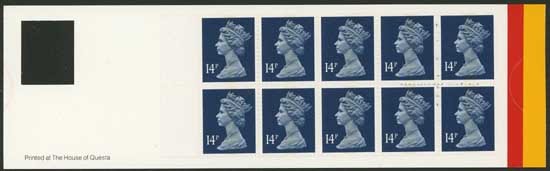
10 x 14p 1.40 with two different codes - "Q" and "R".
10 x 19p £1.90 with two different codes - "M" and "N".
These booklets alone make up a nice mini collection, and are still sold by dealers at a reasonable price. I estimate a full collection without error booklets will cost in the region of £220 -£250. If you wish to add to the collection, look for missing phosphors, low OBA and panes with translucent paper.
They were also issued with cylinder numbers, some of these cylinder booklets are quite scarce and hold good catalogue prices.
Questa booklets: No cylinder booklets are known but they are known with 2 types of perforations /torn or cut panes, also some cut panes have blind holes in the perforations.
Thursday, 17 June 2010
The Stamp Collecting Round-Up
A few weeks back collectors had a debate on Royal Mails publication "the Philatelic Bulletin. It was of the general opinion that it is still a good publication although it is a bit lax (or late) informing readers of important changes to specialist British stamps. By specialist stamps they refer to Machins. I think they are referring to lack of information to the code changes on certain stamps and additions to the codes ie MAIO.
Larry I think got this correct when he wrote a reply on Norvic blog.
While I agree with Ian that the Philatelic Bureau has lost just about all of its philatelic, I think it is not reasonable to criticize the Bulletin for its lack of coverage of Machin Minutiae. By its nature, it has to be a somewhat general publication, and I think the most recent editor (John Holman, now retired) has been correct to leave that topic to Douglas Myall.
Collector interest in that subject and Myall's ability to cover it has been shown by Myall being repeatedly voted best author in the Bulletin. Collectors who want more details (and faster news coverage) should join the MBPC or the MCC...or read these blogs!
Well said Larry, Myall has done more than any other to put Machins on the collecting map, and is still going strong with his article for the Bulletin, not to mention Deegam reports and regular updates to his CD.
I was surprised to see he was not included in the Birthday Honours list :-) If anyone deserves a medal for services to Philately it is he.
Check this out "Why were stamps invented ?"
The Stamp Collecting Round-Up
Larry I think got this correct when he wrote a reply on Norvic blog.
While I agree with Ian that the Philatelic Bureau has lost just about all of its philatelic, I think it is not reasonable to criticize the Bulletin for its lack of coverage of Machin Minutiae. By its nature, it has to be a somewhat general publication, and I think the most recent editor (John Holman, now retired) has been correct to leave that topic to Douglas Myall.
Collector interest in that subject and Myall's ability to cover it has been shown by Myall being repeatedly voted best author in the Bulletin. Collectors who want more details (and faster news coverage) should join the MBPC or the MCC...or read these blogs!
Well said Larry, Myall has done more than any other to put Machins on the collecting map, and is still going strong with his article for the Bulletin, not to mention Deegam reports and regular updates to his CD.
I was surprised to see he was not included in the Birthday Honours list :-) If anyone deserves a medal for services to Philately it is he.
Check this out "Why were stamps invented ?"
The Stamp Collecting Round-Up
Monday, 14 June 2010
Another New Code Discovered (Type 11a)
UPDATE
Sorry if I confuse you folks, I actualy confuse myself sometimes.
It appears I missed this, thanks to Robert for the reminder. See his comments below. My mind goes blank sometimes. I now remember reading about these on Ian's blog sometime last month."The 1st class and 2nd class Large booklets of 4 are now available with code MA10. First seen at the 2010 London exhibition".These have the the same change (as below) to the code and the position of the wavy text is one row down from the previous 2009 printings .
Ian continues "FOYAL has been replaced with ROYAL in the 2010 stamps, and the line below it now incorporates the origin code, MAIL now reading MFIL."
This now gives us 3 different stamps to date with type IIa positioning . We expect the large second class business sheet to turn up soon showing this new MA10 date and changed text.
(LMBIL)
ORIGINAL REPORT
 Ian Billings has returned from his mid summer break ( we hope you have had a relaxing time Ian) and straight away informs us,via his blog, of another new Machin discovery.
"The 1st class gold Large Letter Business Sheet has now been reprinted with the MA10 code. The printing date on the sheet header is 09/03/10."
What is also interesting is the code position has changed to that of a new type. Similar to type 11, but the wording LMBIL forms at the rear of the central cross, rather than on the previous printing where YBLMAIL forms from the centre of the cross.
Should this be listed as code type 1V or type 11A? If we are to use this coding system in catalogues and lists I will leave it to the experts to decide.
It was suggested to me that perhaps code 1, code 2 code 3 code 4 etc may be better. I personally think we should leave this to Mr Deegam, he seems to think ahead and has a proven track record with a good grasp of nomenclatures.
You can view my previous posts on the different types of codes here. and here
GB Machins Makes It To Number 1

The GB Machins web site (Machins Made Easy) has been awarded number 1 position on the top 50 stamps sites league.
Even though the site is nothing special as Machin sites go, (I can think of at least 5 others that would knock spots off it), I would like to say thanks to everyone who (takes) took out time to vote for it on Top 50.
The GB Machins website is not updated often these days as it is affiliated to this site and most of the news which should be incorporated into it gets posted here. I have in fact taken off the Prestige booklet information there and the alternative GB section for the time being. These will eventually be re- incorporated into the Online shop which I am attempting to build from scratch.
As mentioned above I am adding to the site in bits and drabs and I am trying to get to grips with publishing the shop there, lack of time and certain niggles with the pay pal system are making this a long job. I have to publish each section as I progress to check the Pay Pal links work, some are still faulty and proving to be pain the neck, but I intend to persevere.
Please bear with me regarding the shop departments, several more are planned for the future, the ones that are linked may not work correctly at this time, so even if you do not or wish to purchase anything the information loaded to date may come in handy as a reference for collectors, as I say this is a big job and my time is short these days, so do not hold your breath for to long, just pop back now and again to check on the progress.
Now that GB Machins has reached top spot, I know its not a big deal in reality but to try to keep it there as number 1 please click on the Machins Made Easy link in the header above and add your vote each time you visit this site.
Again MANY THANKS to everyone.
....Roy
Friday, 11 June 2010
Royal Mail May Be Sold

Recently Larry mentioned that Enschede may bid for more stamp contracts. He could be right.
News just in
It is no secret that Britain is up to its arm pits in debt and needs money badly. We have been warned that in the forthcoming budget cuts are coming and more cuts will continue to come throughout the next 5 years. One such cut will see 500 years of history laid to rest.
The new Conservative/Liberal Democrat coalition have intentions of selling off Royal Mails delivery business, it is said they will retain the the Post Office network and keep this in public ownership.
Ed Davey, the Postal Affairs Minister, said he was considering a full-scale privatisation as one of the options to raise money urgently for the beleaguered company. Any float could value Royal Mail at as much as £9 billion. It is also suggested that Holland’s TNT was reported to be considering buying a 33 per cent stake for £3 billion.
Holland, TNT, Enschede???
A brief history of Royal Mail
1516 Henry VII established a “Master of the Posts”, a position which evolved into the office of the Postmaster General.
1635 Charles I made the postal service available to the public, with the cost of postage being paid by the recipient.
1654 Oliver Cromwell granted a monopoly over the mail delivery service in England to the “Office of Postage”.
1657 Fixed postal rates were introduced.
1660 Charles II established the General Post Office.
1661 The postage date stamp was first used, and the first Postmaster General was appointed.
1784 The first mail coach was introduced between Bristol and London. Early mail coaches were similar to ordinary family carriages but bore the Post Office livery.
1793 Uniformed Postmen hit the streets for the first time.
1830 The first mail train from Liverpool to Manchester Railway made its first deliveries.
1837 Rowland Hill , a schoolmaster from Worcestershire invented the adhesive postage stamp – an act for which he was knighted.
1838 The Post Office Money order system introduced.
1840 The first adhesive postage stamp, the Penny Black , was released nationally, and the Uniform Penny Post , by which letters could be sent for one penny, was established.
1852 The first Post Office piller box was erected in Jersey.
1853 The first post boxes were erected in mainland Britain.
1857 The first wall boxes were installed Shrewsbury and Market Drayton.
1870 The Post Office Launched its telegraph service. The same year the Post Office Act banned sending of “indecent or obscene” literature; introduced the ½d rate for postcards, and provided for the issue of newspaper wrappers. The first postcards were also issued.
1880 Postmen began to use bicycles to deliver the mail. (These were phased out in 2010)
1881 The postal order was introduced.
1883 The Parcel post began.
1912 The Post Office opened its national telephone service .
1968 2nd class stamps were introduced and the National Giro Bank opened.
1969 Under the post office act of 1969 , the General Post Office changed from a government department to a nationalised industry.
1971 Postal services in Great Britain were suspended for two months between January and March as the result of a national post strike over pay.
1974 The system of postcodes was rolled out across Britain.
1977 The Telegram service was abolished.
1981 The Telecommunications arm of the postal service split off from British Telecom. The remainder of the business is renamed as the "Post Office".
1986 The letter delivery, parcel delivery and post office arms of the mail service was split into three separate businesses under the name Post Office Group.
1988 Postal workers held their first national strike for 17 years over bonuses being paid to recruit new workers in London and the South East.
1990 Girobank was sold to the Alliance and Leicester Building Society and the Royal Mail Parcels business was re branded as Parcelforce.
2001 The Post Office Group is renamed Consignia in a massive, but short-lived, re branding exercise which waisted £12 million of tax payers money.
2002 15-months after it was renamed Consignia, the postal service is renamed The Royal Mail.(another 13 million wasted) John Roberts, chief executive, announced his departure from the group after announcing annual losses of £1.1bn.
2004 Deliveries reduced to once-daily.
2005 Mail Trains were reintroduced on some lines.
2006 Royal Mail lost its monopoly on the postal service when the regulator, PostComm, opened up the market three years ahead of the rest of Europe. Competitors can carry mail and pass it to Royal Mail for delivery. Pricing in Proportion (Pip) is also introduced for first and second class inland mail.
2006 Online postage allowed Royal Mail customers to pay for postage on the Internet, without the need to buy traditional stamps.
2007 Official industrial action took place over pay, conditions and pensions and Sunday collections from pillar boxes end. Royal Mail announces plans to close 2500 Post Office branches.
2009 The Communication Workers Union opened a national ballot for industrial action and workers vote to strike over pay and jobs. Lord Mandelson, the Labour business secretary, launched his attempt to privatise the Royal Mail. The bid failed after the CWU stirred up a storm of backbench revolt.
I WONDER WHY THEY ARE LOSING MONEY?
They pay their cheif executive 3 million a year (WHAT FOR?)

If you want to send a package to Vladivostok, in the far east of Russia, Royal Mail will charge you less than it would to send the same item to Vauxhall, in inner london.
2010 back to the top.
Thursday, 10 June 2010
John Hedgecoe 1932-2010
Photographer John Hedgecoe passed away recently (one source says June 3, another says June 7). We've discussed Hedgecoe's role in the development of the Machin, though sadly most articles are repeating the bilge about him taking "the" photograph that was used on the Machin definitives.
Maybe now we can begin to set the record straight.
--Larry
Maybe now we can begin to set the record straight.
--Larry
Wednesday, 9 June 2010
Security -Cut Stamps ( No Security Overlay)

Previously only used stamps with cuts and no overlay had been found in kilo ware. These were found at a time when quite a few forgeries (other security types)were flooding the market and collectors were rightly suspicious that they may be forgeries also.
Since the initial debate they have been listed in Deegam Report 87 as genuine stamps, but at the time of the Deegam report only used copies known.
We have it on good authority that Royal Mail confirmed that the 1st class gold security-cut stamps with no security overlay are a genuine product. Details known to date is the combination occurred when there was a need for 1st class rolls of 10,000 ahead of the release of the security rolls which were due to be released in February 2009.
Mint examples (singles and strips) of these stamps have now started to turn up on eBay and collectors are having a another serious debate on the Machin Forum as to the validity of them.
They are quite expensive at the moment, but like any other product if they are available in any numbers then the price will eventually find its level. The seller does not give any indication of the amount of stock he holds , but does give something away in the fact he states he has offered them to specialist dealers.
Brummie Bill, a member of the Forum asked the seller to send him a high resolution scan of a single from the strip so that I could gauge the measurements of the slits and the type settings. The measurements of the slits all seemed to be correct as per Deegam Report 87
For convenience Bills original scan is reproduced here.

The value settings have now been measured and Bill goes on to say "The value setting also appear correct (h=1.75mm, v=3.0mm assuming the cut is 3mm wide)."
Visit The Machin forum and add to the debate, you can also leave your comments here.
More Auction News
 Machin Gold Horizon Tete Beche Labels (mint) have started to appear again on eBay. So these are not so rare as we first thought. The price has dropped accordingly. I quite like these, and I think it is something that will enhance a mint collection for little money. My advice fill your boots whilst the going is good.
Last time I visited the auction there were 10 available as a buy it now product for £5.40, postage and packing is free. According to his feedback he (she) has sold eight of these mint pairs to date. It is not known how many more are held in stock.
Another nice Item
The same seller (hksilver) is also offering these Tete Beche pairs used @ £8.60 + £1.40 postage and packing.
Tuesday, 8 June 2010
Enschede Continued
I think I have this correct, the last Machin (sheet) definitive to be printed by Enschede was the emergency issue , which was a new 35p stamp in lime green (similar to the colour previously used for the 6p stamp). It was issued on 4th April 2005 with one phosphor band for the 100gr 2nd class rate.
It was not on sale for long as De La Rue reprinted it shortly after (also centre bar) cylinder D1 D1 24/07/05. The reason given for the emergency printing was " De La Rue had just moved into the Dunstable plant (March 05) and had not yet fully set up the equipment for full production."
I have actually learnt something from Larry's post as I did not know that Enschede was pronounced en-ske-day'). I must have sounded like a "Right Silly Billy" when discussing these printings with colleagues as I have always pronounced it En-she-dee. No wander I got funny looks from my audiences :-)

I have just noticed looking at this picture that the printers name was also in a different type face for this issue. It just goes to show that even though my head is stuffed with useless information, if one perseveres one can learn something new every day.
It was not on sale for long as De La Rue reprinted it shortly after (also centre bar) cylinder D1 D1 24/07/05. The reason given for the emergency printing was " De La Rue had just moved into the Dunstable plant (March 05) and had not yet fully set up the equipment for full production."
I have actually learnt something from Larry's post as I did not know that Enschede was pronounced en-ske-day'). I must have sounded like a "Right Silly Billy" when discussing these printings with colleagues as I have always pronounced it En-she-dee. No wander I got funny looks from my audiences :-)

I have just noticed looking at this picture that the printers name was also in a different type face for this issue. It just goes to show that even though my head is stuffed with useless information, if one perseveres one can learn something new every day.
Monday, 7 June 2010
More Enschedé Machins?

While I was in London, I attended a talk at the BPMA by Paul Eimers, a representative
of the Dutch printing firm Royal Joh. Enschedé (commonly known to collectors simply
as Enschedé, pronounced en-ske-day').
He was mostly there to talk about the reproduction of four George V stamp
designs on the souvenir sheet issued for the London 2010 Festival of Stamps.
I believe Enschedé is the only Royal Mail printer that still has the
capability to produce stamps by intaglio.
(Bottom line: the human engraver has been replaced by a designer, a
Computer Aided Design program, and a computer controlled laser.)
Of interest to Machin collectors was an off-hand comment he made that
Enschedé currently only prints the occasional special issue for Royal Mail.
However, he said that they are very close to becoming a more important
supplier of stamps.
I asked him about this after his talk. He said that Royal Mail has
competitive bidding for its contracts, and that they are very eager
to do more business with Royal Mail. He didn't mention Machins specifically,
but I have no doubt that would be at least part of what they would be
trying to get.
I've pictured a stamp with the identifier that Enschedé used in the good
old days when Royal Mail allowed its printers to identify themselves on
their products.
--Larry
Subscribe to:
Posts (Atom)